

Overview of the Dragon Caves
Located near the town of Porto Cristo on the eastern coast of Mallorca, the Cuevas del Drach (Dragon Caves) rank among the most popular natural attractions in the Balearic Islands. The cave system comprises four interconnected caverns: the Black Cave, the White Cave, the Cave of Luis Salvador, and the French Cave, together extending approximately 1,200 meters in length and reaching depths of up to 25 meters below the surface.
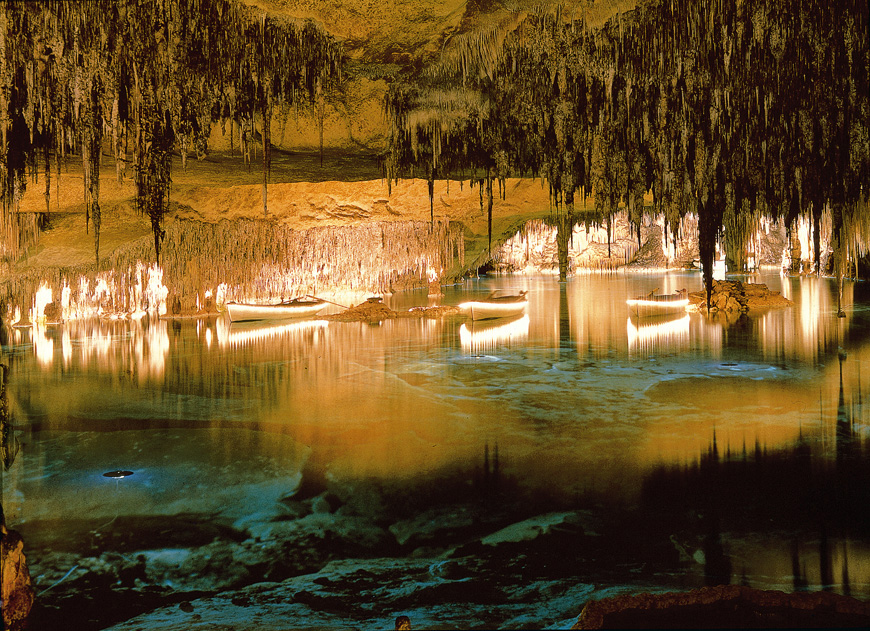
The undisputed highlight of any visit is Lake Martel (Lago Martel), an underground lake measuring 177 meters in length and 40 meters in width. Named after the French speleologist Edouard-Alfred Martel who explored it in 1896, it is one of the largest underground lakes in the world. The lake's perfectly still surface creates mirror-like reflections of the surrounding stalactites, producing an almost surreal visual effect.
The Underground Concert Experience
What truly sets the Dragon Caves apart from other cave attractions is the live classical music performance staged on Lake Martel. As visitors gather along the lake's natural amphitheater, the chamber lights dim to near darkness. Then, slowly, illuminated boats carrying musicians appear on the water, performing pieces by composers such as Bach and Chopin. The acoustics of the natural chamber create a resonance that rivals purpose-built concert halls.
After the roughly ten-minute performance, visitors have the option to cross Lake Martel themselves by boat, a brief but unforgettable journey across the glassy waters surrounded by ancient formations. Others can walk along the pathways that circle the lake to continue their exploration.
Practical Visitor Information
Opening Hours
November 1 to March 16: tours at 10:30, 12:00, 14:00, and 15:30. March 17 to October 31: every hour from 10:00 to 17:00. Closed December 25 and January 1.
Ticket Prices (2025)
Adults: 17.50 EUR (online) / 18.50 EUR (on-site). Children ages 3 to 12: 10.50 EUR (online) / 11.50 EUR (on-site). Children under 3 enter free. Tickets can be booked up to 30 days in advance on the official website.
Duration and Conditions
The full tour lasts approximately one hour, including the concert and optional boat crossing. Interior temperature stays between 17 and 21 degrees Celsius year-round. The pathways are paved but may be slippery in places.
Getting There
The caves are located about 65 kilometers east of Palma de Mallorca, a drive of roughly one hour along the MA-15 motorway. Public buses run from Palma and other major resort towns during the tourist season. Ample free parking is available at the site. Many visitors combine a cave tour with a visit to Porto Cristo, a picturesque fishing village with a lovely harbor and beach just minutes away.
History and Exploration
While the caves have been known to locals for centuries, their modern exploration began in 1880 when German speleologist M.F. Will mapped the first sections. The French explorer Edouard-Alfred Martel led a more comprehensive expedition in 1896, discovering the underground lake that now bears his name. The caves were opened to the public in the early twentieth century and have since become one of Mallorca's signature attractions, drawing hundreds of thousands of visitors annually.
Literary enthusiasts may be interested to know that the caves feature in the works of Jules Verne, whose vivid descriptions of underground worlds were partially inspired by the subterranean landscapes of Mallorca.
Tips for Your Visit
- Arrive at least 15 minutes before your scheduled tour time, as latecomers may not be admitted
- Bring a light jacket; the temperature underground is noticeably cooler than outdoor summer conditions
- Wear comfortable, non-slip shoes for navigating the pathways
- Rain does not affect cave visits, making this an excellent option for uncertain weather days
- Photography is permitted but flash is prohibited to protect the formations
- No refunds are issued for missed time slots, so plan your arrival carefully
- Consider visiting during the shoulder season (March-May or September-October) for smaller crowds
Nearby Attractions
The eastern coast of Mallorca offers plenty to see beyond the caves. Porto Cristo's harbor and beach provide a pleasant spot for lunch after your visit. Nearby, the Coves dels Hams offer another cave experience with their own underground lake. The town of Manacor, just inland, is known for its artificial pearl factories and historic center. Nature lovers should consider a day trip to the Mondrago Natural Park, located further south along the coast, where pristine coves and walking trails await.
For more information, visit the official Cuevas del Drach website or check the Spain Tourism Board for regional travel planning.

